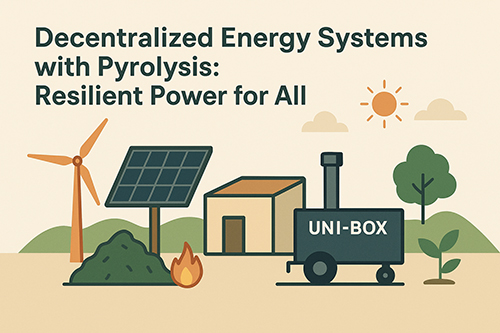
A containerized pyrolysis unit is a complete pyrolysis reactor system built into a modular enclosure, typically sized to standard shipping-container dimensions, so the entire system can be transported by truck or rail and installed without permanent on-site construction. The container houses the reactor, feed system, and emissions handling in a single self-contained module, which is what makes mobile deployment practical in the first place.

This design choice solves a specific problem: traditional pyrolysis facilities require fixed foundations, custom-built structures, and long construction timelines. A containerized unit is manufactured and tested off-site, then delivered ready to connect, cutting deployment time from years to weeks.
Core Components of a Containerized Pyrolysis Unit
- Reactor chamber — the oxygen-free heating chamber where thermal decomposition happens.
- Feed system — handles intake of waste material, sized for the target feedstock (wood chips, crop residue, manure, tire chips, etc.).
- Char, oil, and gas separation systems — route the three output streams to storage or immediate use.
- Control systems — monitor temperature and process conditions to keep output consistent and emissions compliant.
Because everything ships in one enclosure, site prep is limited to a level pad and utility connections rather than a construction project.
Dive into the design of containerized pyrolysis units that convert diverse waste streams into valuable energy and byproducts. Built for transport by truck or rail and ready to connect with minimal site prep, these systems offer a flexible alternative to traditional fixed-plant facilities. Learn how the UNI-Box processes feedstocks ranging from mining residues to railroad ties, and how modular scaling supports industries from mining to emerging data-center applications.
Why “Containerized” Matters for Scalability
A single containerized unit has fixed throughput. Operators scale capacity by adding units side by side rather than building a larger single facility. This modular approach means a small operation can start with one unit and expand as volume grows, without redesigning the system or overbuilding for capacity it doesn’t yet need. It also means a unit can be relocated to a new site if a waste stream shifts or a contract ends, an asset a fixed facility can’t offer.

What Containerized Units Process
Feedstock flexibility depends on the specific reactor design, but containerized pyrolysis units are currently deployed against:
- Creosote-treated railroad ties
- Coal fines and mining residues
- Wood waste, sawdust, and forestry residue
- Manure and crop residue
- Food processing waste (peels, husks, shells, sludge)
- Sewage sludge and biosolids from water treatment
- Mixed plastics and end-of-life tires (where certified)
Published dry-weight yield data on units processing coal, wood, manure, and agricultural waste shows meaningfully different output ratios by feedstock, coal-heavy feed skews toward char output, wood-heavy feed skews toward oil and gas, which is worth confirming with a vendor before sizing a project around a specific feedstock.
Containerized vs. Traditional Fixed-Plant Pyrolysis
| Factor | Containerized Unit | Fixed Plant |
|---|---|---|
| Deployment time | Weeks | Often 1-3+ years including permitting |
| Site requirements | Level pad, utility hookups | Foundation, structure, full civil work |
| Relocatable | Yes | No |
| Capacity scaling | Add units incrementally | Fixed at construction |
| Upfront capital | Lower per unit | Higher, sized for max expected volume |
Industries Using Containerized Pyrolysis
Railroads, agricultural operations, coal and mining companies, paper and timber mills, food processors, municipal solid waste programs, and water treatment facilities are current adopters. Data centers processing tire-derived carbon for energy generation are an emerging use case as power demand for AI infrastructure grows.
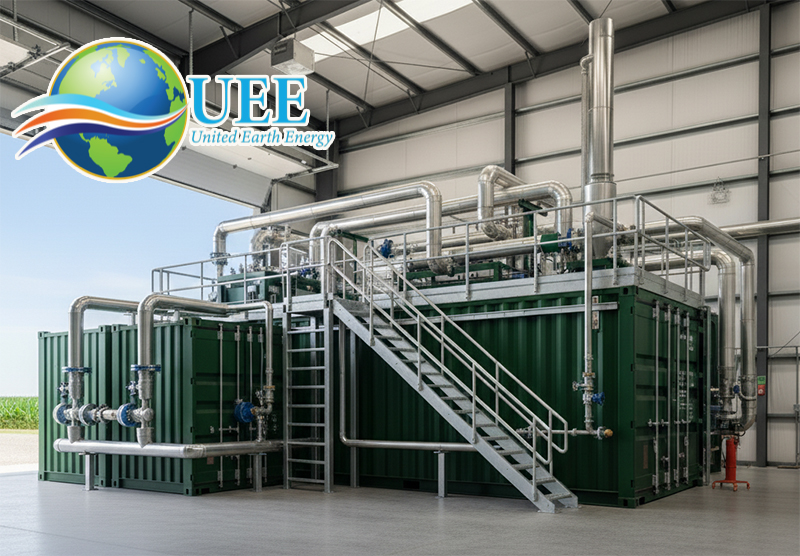
The UNI-Box: A Containerized Pyrolysis Unit in Operation
United Earth Energy’s UNI-Box is a direct example of the containerized design described above: a complete reactor, feed system, and separation equipment built into a single modular enclosure that ships and installs without permanent construction.
What sets the UNI-Box apart within this category:
- Multi-feedstock reactor — the same containerized unit is EPA-compliant for coal, wood, manure, and agricultural waste, rather than being built around a single waste type.
- Documented yields by feedstock — published dry-weight output data shows coal yielding roughly 65% char, wood yielding roughly 40% oil, and manure/ag waste splitting close to evenly across char, oil, and syngas, giving operators real numbers to size a project against instead of vendor estimates alone.
- Add-a-unit scaling — throughput increases by deploying additional UNI-Box modules side by side, so capital outlay tracks actual waste volume rather than requiring upfront overbuild.
- Active deployment — currently in use for railroad tie disposal, with tire-feedstock certification and a dedicated monofill facility (Odessa, TX) in progress.
For feedstock-specific sizing or a project quote on a UNI-Box unit, call United Earth Energy at 737-497-8827.
Frequently Asked Questions
How big is a containerized pyrolysis unit? Units are typically built to standard shipping-container footprints for road and rail transport, though exact dimensions vary by manufacturer and reactor capacity.
Do containerized units require special permits? Yes, permitting is feedstock-specific. A unit compliant for coal, wood, manure, and agricultural waste is not automatically compliant for tire pyrolysis, which usually requires separate certification.
Can a containerized pyrolysis unit be moved once installed? That’s the core advantage of the design, relocation is possible without the demolition and rebuild costs a fixed facility would require.
What’s the difference between a containerized unit and a mobile pyrolysis plant? “Containerized” refers to the modular, shippable construction; “mobile” refers to the functional ability to relocate the system. In practice the terms are often used interchangeably because containerized construction is what enables mobility.
United Earth Energy’s UNI-Box is a containerized, EPA-compliant pyrolysis system serving railroad, agricultural, mining, and industrial clients. Call 737-497-8827 for a project quote.